

by Joshua Kohl (DAE composer/musician/producer)
Where to begin. I suppose gratitude should come first. I am sitting in the hotel lobby in Perth Australia on the day before I depart on the lonnnnnnnng trip back to Seattle. My being here was made possible by the PADx program of the Western Arts Alliance supported by the US State Department with additional support of The Grocery Studios in Seattle. To all three, I bow in deep gratitude for this absolutely mind opening experience. Thank you.
The International Society of Performing Arts (ISPA) Congress is a gathering that takes place all over the world to bring together arts presenters, artists and policy makers to meet, discuss, debate and talk about solutions to current challenges in the international performing arts sector and to propose new exciting ideas for the future. It is not a booking conference or an arts market. It is truly a place of conversation.
I recognize the great privilege that I have been given as one of only 5 artists from the US chosen for this opportunity, and I have done my best to make the very best use of my time here and hope to be able to share back my reflections and perceptions that this experience has inspired.
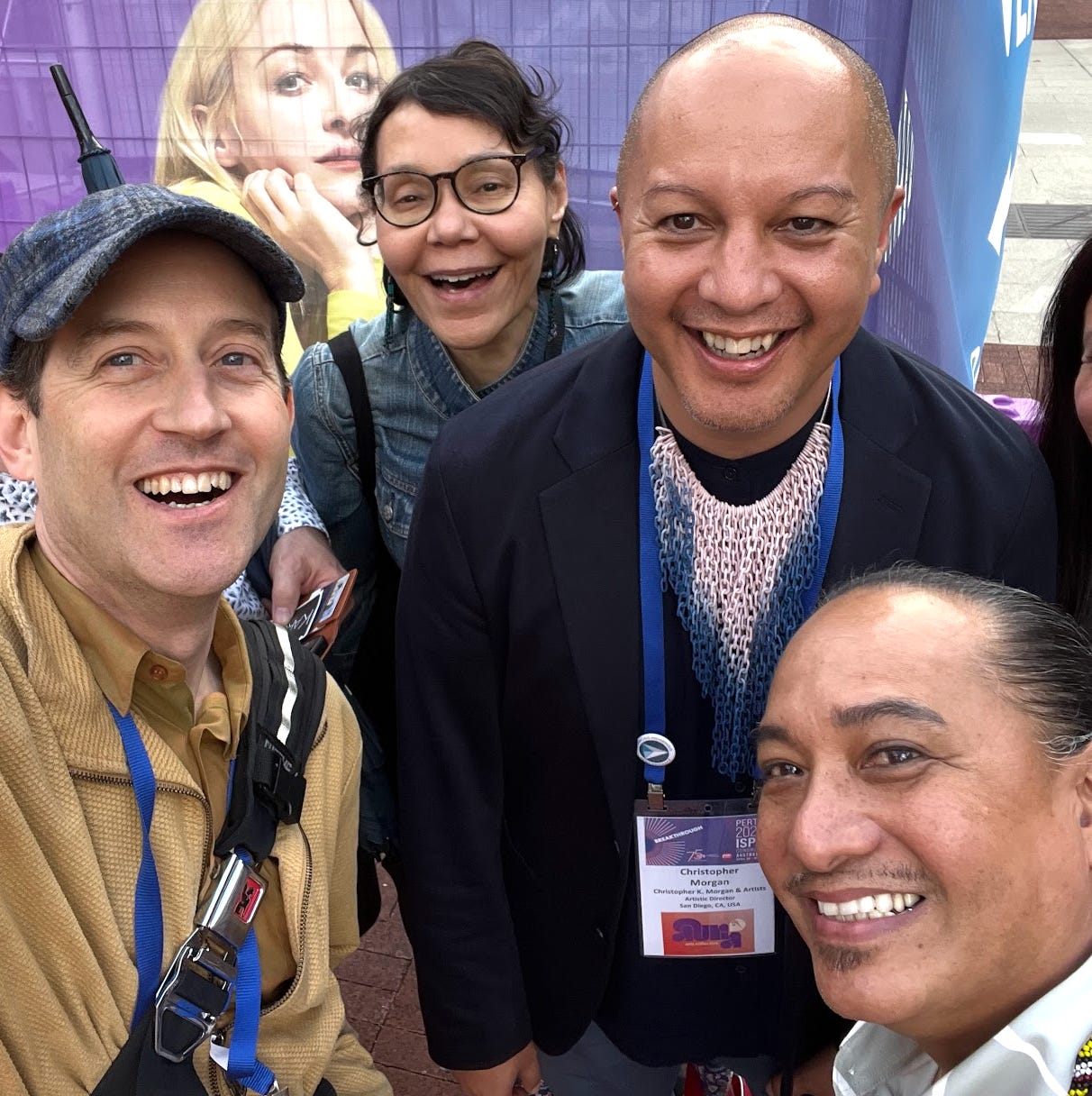
My journey here was taken along with three other profoundly deep and kind artists from the US. Two choregraphers: Tau of Tau Dance Theater from Hawaii and Christopher Morgan from San Diego and the wonderful singer Thea Hopkins. A good deal of the focus of the congress has been on indigenous artists from around the world, and it has been a particularly deep experience being on this journey with three indigenous artists and learning an enormous amount from their perspectives.
According to many of the theater presenters, funders and producers at the conference, since the pandemic, much of the world’s performing arts world have turned inward. European presenters are mostly presenting European artists. US presenters are presenting fewer international artists. Here in Australia, there is more of a focus on the Asia Pacific region for touring exchange. The primary driver has been inflation, pushing up travel and material costs. And people are talking about the carbon footprint of presenting international travel. This all makes sense, but I can’t help feeling a tremendous loss in it as well. I can’t begin to quantify the amount of inspiration we have gotten from experiencing work from overseas. From the earliest butoh performances we witnessed such as Kazuo Ohno or Butoh Sha Tenkei, to recent mind blowers like Ontroerend Goed’s mind boggling backwards performance at Push Festival last year, or Robyn Orlin’s And so you see... our honourable blue sky and ever enduring sun... can only be consumed slice by slice... to name just a tiny sampling. Where would we (and when I say “we”, I literally mean Crow and I - and the very existence of Degenerate Art Ensemble) be without this critical circulation? This turning inward combined with a far reaching populist right wing swing across the planet is peeling back so much good that also exists on this planet, and makes our worlds and minds ever smaller and smaller.
Something that continually struck me, being among some of the most powerful tastemakers in the performance world at the ISPA conference, is how consolidated the power is in the performing arts. A small handful of people hold the keys to most of the opportunities, and those with power share access within their tight knit circles. How little power the artists themselves hold in the system is very evident, yet it doesn’t ever seem to be a topic of concern. I have always wanted to work towards building alternative models in which artists could share resources with each other and support one another and hold some of the reins within the system that supposedly exists for them to thrive. I think that artists and non-artist curators would make very different curatorial decisions, and I deeply believe that both voices are relevant.
I had the pleasure to catch a performance "SILENCE" by Karul Projects produced by BlakDance. It is an energized and politically driven work by a First Nations choreographer. The music was mostly a one-person score of drums, voice and electronics created and performed immaculately by JHINDU-PEDRO LAWRIE. Wow, he didn’t miss a beat. Very cool to get a taste of the indigenous performance scene in Australia.
The ISPA conference is pretty fascinating, and I had the opportunity for lots of brainstorming and sharing with so many artists, producers and presenters from around Australia and around the world.


I would be remiss if I didn’t share a few of my favorite wild Quokka pics. Quokkas, also known as kangaroo rats, are particularly abundant on the island of Rottnest, 30 minutes off of the coast of Perth. They are amazingly indifferent to human presence. They don’t pay any attention to you. For these photos, I was lying on the ground next to them with the camera only inches away! They didn’t pay me any attention.


